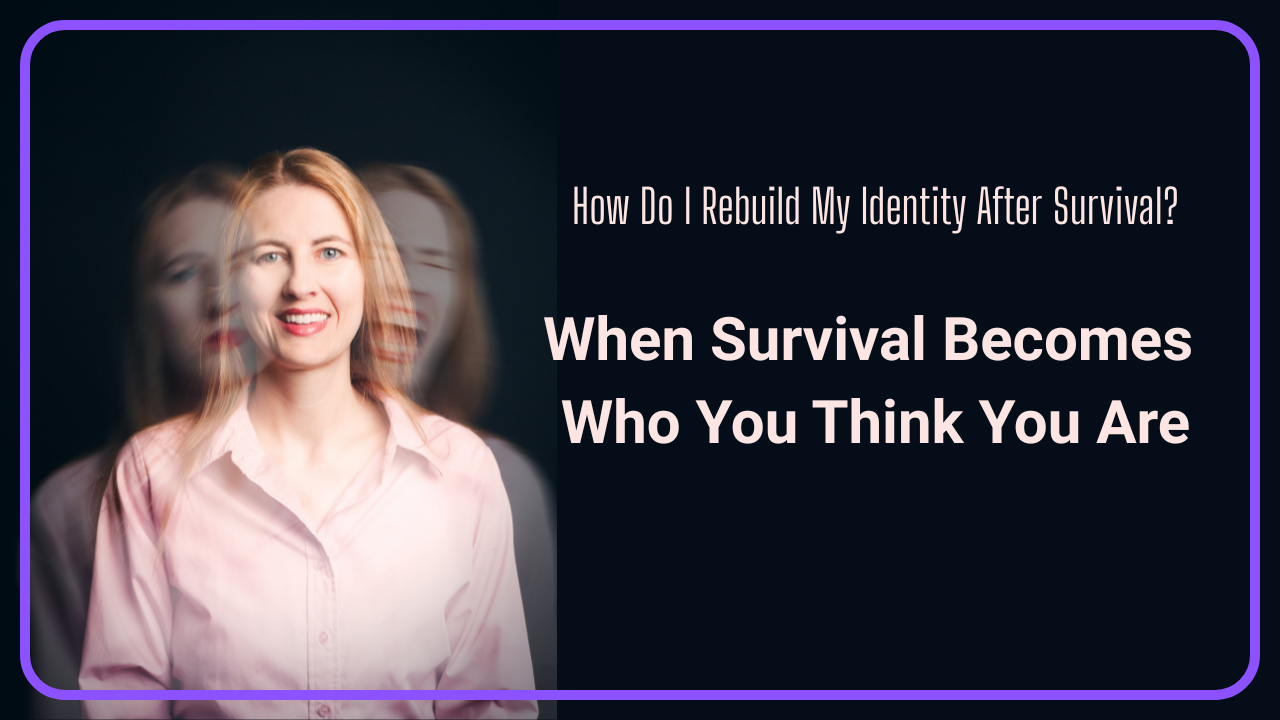
Q: How Do I Rebuild My Identity After Survival?
When Survival Becomes Who You Think You Are
Survival mode often begins as a response to something difficult, unsafe, or unpredictable.
You learn how to read the room. You try to stay one step ahead. You become careful about what you say and how you act. You manage your environment because control feels safer than uncertainty.
Over time, these behaviors stop feeling like responses to the past. They begin to feel like your personality.
You may believe you are simply a responsible person, the good one, the dependable one, or the person who keeps everyone together. You may take pride in being the one who can handle anything.
But underneath those roles is often a fear of getting something wrong.
If something goes badly, you expect to be blamed. If someone becomes upset, you wonder whether it was your fault. You work hard not to disrupt the energy around you or call too much attention to yourself.
This is where people pleasing can become part of a survival identity.
You say yes because you want to keep the peace. You help because being useful feels safe. You notice what everyone else needs before checking in with yourself.
Then your feelings are hurt when people do not offer the same care in return.
You may think, “I do everything for everyone. Why does no one do the same for me?”
The deeper issue is that the giving was not always coming from a free and conscious choice. Part of it was connected to protection, belonging, and safety.
Control Can Feel Like Safety
Control is often fear wearing a more acceptable outfit.
You may plan every detail, monitor everyone’s mood, or prepare for every possible outcome. These behaviors can look organized and capable from the outside. Internally, you are trying to prevent blame, judgment, rejection, or another painful experience.
In a previous episode of This Life or Something Better, I described control as a response to the absence of psychological safety. When mistakes were not tolerated, uncertainty led to chaos, or speaking up had consequences, staying in control became a way to protect yourself.
The problem is that control does not create true safety.
It creates tension.
You are constantly watching, anticipating, and adjusting yourself. You may feel responsible for keeping other people calm, even when their emotions and choices are not yours to manage.
Eventually, the controller, the good one, and the people pleaser become identities you believe you have to maintain.
Then something begins to change.
You recognize that these roles are exhausting. You begin setting boundaries or questioning why you have to carry so much.
That is often when fear arrives.
Why Letting Go Can Feel So Uncomfortable
When someone begins releasing control or people pleasing, their first reaction is usually fear.
They believe the world may fall apart around them.
What if someone becomes angry?
What if they are disappointed?
What if they stop needing me?
What if I say no and the relationship changes?
The old identity may have been exhausting, but it was familiar. You understood the rules. You knew how to be helpful, agreeable, quiet, responsible, or in control.
A new identity does not come with the same certainty.
This is why change can feel wonderful at first and then lead to a slump.
There may be an initial sense of freedom. You finally say no. You stop fixing something that was never your responsibility. You allow someone else to handle their own problem.
Then the question appears:
Who am I now?
You wore survival like a badge of honor. It became evidence of your strength and resilience. People may have praised you for how much you could manage.
When you stop performing that role, there can be a period of emptiness.
You no longer want the old story, but you have not yet created a new identity.
Become the Observer Before You Respond
One of the first things I ask clients to do is become an observer of their behavior.
Before responding to a request, conflict, or uncomfortable moment, step outside of the usual reaction and watch what is happening.
Imagine observing the situation from outside of your body.
What are you noticing?
Are you preparing to say yes before you even know what is being asked?
Are you trying to control the outcome?
Are you changing your opinion because someone else seems uncomfortable?
Are you about to take responsibility for something that does not belong to you?
You do not have to change the behavior immediately.
Observation comes first.
When you can see the pattern, you create space between the request and the automatic response.
This is where the Pause, Breath, Notice, and Choose process becomes important.
Pause before reacting.
Take a breath and come into your body.
Notice the thoughts, tension, and urge to manage the moment.
Then choose how you want to respond.
A reaction is connected to the old identity. A response allows the person you are becoming to participate in the decision.
Put “No” on the Calendar
People pleasers often know they are overextended, but saying no in the moment can feel almost impossible.
They begin explaining, apologizing, or backpedaling. Before they know it, they have agreed to something they did not want to do.
One simple practice I teach is to put the word NO into the calendar as a recurring event.
When someone asks for help, you can look at the calendar and say, “My calendar says no.”
It may sound simple, but it creates a structure that supports the change.
You are not trying to come up with the courage, words, and explanation while standing in front of someone who expects an answer. The decision has already been made.
Your calendar becomes the boundary until the boundary feels more natural inside of you.
The goal is not to say no to everything. It is to interrupt the habit of saying yes to everything.
One successful interaction can begin changing your identity.
You recognize that you said no and the world did not collapse. The person may have been disappointed, but you survived their disappointment. The situation continued without you managing it.
That becomes evidence.
Change happens through these small moments. You begin trusting yourself because you did something different and remained safe.
Rebuilding Begins With Your Values
When the old roles begin to loosen, I usually start identity work with values.
Your values give you something solid to build upon.
They help answer the question, “Who am I without the survival story?”
You may value honesty, freedom, compassion, creativity, stability, respect, growth, connection, or service.
The important part is not creating an impressive list. It is noticing whether your life reflects what matters to you.
You may say that honesty is one of your values, but regularly say yes when you want to say no.
You may value health, yet continue exhausting yourself to meet everyone else’s needs.
You may value respect, but speak to yourself in ways you would never speak to another person.
When you act against your values, you often feel off, unsettled, or out of alignment.
That uncomfortable feeling is information.
It may not mean that something is wrong with you. It may mean that your behavior does not match who you are trying to become.
Move From DO–HAVE–BE to BE–DO–HAVE
Most people have been taught to live through the DO–HAVE–BE model.
They believe they must do certain things, have the right results, and then they will finally become the person they want to be.
I will work harder, have success, and then I will feel confident.
I will take care of everyone, have their approval, and then I will feel worthy.
I will control the outcome, have safety, and then I can relax.
This model keeps identity dependent on circumstances and other people.
I teach the BE–DO–HAVE model instead.
Begin by asking who you want to be.
Then take actions that align with that identity.
The results and resources follow from the way you are being and the actions you consistently take.
If you want to be a person who respects her own energy, you may say no when you are overextended.
If you want to be someone who speaks honestly, you may express an opinion without trying to control how it is received.
If you want to be grounded, you may pause and notice your body instead of immediately rushing into action.
The identity comes first.
In my teaching on becoming your ideal self, I encourage people to begin with “I am a person who…” and then make choices from that statement. Commitments are not made only through words. They become real through action.
Promises Are Made With Words, but Commitments Are Made With Actions
You can promise yourself that you will stop people pleasing.
You can say you are going to set boundaries, speak up, or take better care of yourself.
But the new identity is not built by the promise.
It is built through the next action.
This does not require dramatic change. In fact, large declarations can become another way to perform instead of transform.
Choose a small commitment you can keep.
Pause before answering one request.
Allow someone else to solve one problem.
Share one honest opinion without adding a long explanation.
Take one walk while paying attention to how you hold your body.
Each action sends a message to your mind and body:
This is who I am becoming now.
You are creating evidence that you can live differently.
Do Not Rebuild Alone
There is often a lonely period between the old identity and the new one.
The people around you may be accustomed to the version of you who says yes, takes charge, solves problems, and keeps everyone comfortable.
When you change, the environment may try to pull you back into the old role.
This does not always mean people are intentionally working against you. They may simply be responding to the version of you they know.
A supportive group can make the transition easier.
A class, counseling environment, or community such as Women’s Power Hour can place you around people who are also examining their patterns and creating new ways of living.
You see that you are not the only person who feels uncomfortable when setting a boundary or questioning an old role.
A new environment helps normalize the new identity.
You need people who can see who you are becoming, not only who you have always been.
What a Healthy Identity Looks Like
A healthy identity is aligned with your values.
You understand how to use Pause, Breath, Notice, and Choose when an old reaction appears.
You are more connected to your body and can recognize when it is holding stress.
You speak because you have the right to express an opinion, not because you need to force someone to hear, agree with, or validate you.
You let go of some of your expectations so you can be present with what is actually happening.
This does not mean you never feel fear, become tense, or return to an old behavior.
It means you notice sooner.
You know how to come back to yourself.
You no longer need control to prove that you are safe. You begin developing an inner stability that says you can handle what happens, even when you do not control the outcome.
My Own Identity Changed Through Grief
After my father passed, I spent about a year trying to keep working and pushing through grief while spiritual experiences were beginning to happen around me.
From the outside, continuing to function could have looked resilient.
Inside, I was resisting the changes happening in my life.
Eventually, I reached a point at work where I could not continue. I told my boss I needed to take the following week off.
That pause became the beginning of something new.
I stopped trying to return to the person I had been before my father’s passing. I began adapting to what was opening within me.
That experience became the beginning of my spiritual path and the work I have now done for more than twenty years. The story stopped being only about what had been taken from me. It also became connected to who I was becoming and how I could serve others.
I did not rebuild my former identity.
I allowed a new one to emerge.
You Are Always Becoming
Rebuilding your identity after survival does not mean creating one final version of yourself and staying there forever.
We are always becoming.
We live in the present, yet life continues unfolding for our growth as a soul and as a human being.
Stuff happens.
It is part of the human experience.
We are all doing the best we can with the tools we have at the time.
The question is not whether you will ever face another challenge. The question is whether you will meet that challenge from alignment or from an old survival identity.
When you feel off, pay attention.
You may be acting against something you value.
Come back to who you want to be.
Be that person first.
Then do the things that align with that identity.
From those actions, you will discover the resources and resourcefulness to create the life you want to live.
A Reflection to Begin Rebuilding
Ask yourself:
Who have I believed I needed to be in order to stay safe?
Then ask:
Who do I want to be now that I am no longer living in that experience?
Do not rush the answer.
Your new identity may not arrive in one moment. It will reveal itself through the choices you make, the values you honor, and the commitments you keep.
You are not losing yourself by releasing the survival identity.
You are creating enough space to meet the person who has been underneath it all along.
For a deeper conversation about survival, adaptation, and resilience, listen to Still Living in Survival Mode? How to Turn Pain Into Resilience on This Life or Something Better.
LISTEN TO THE EPISODE on Spotify, Apple Podcasts or Amazon Music