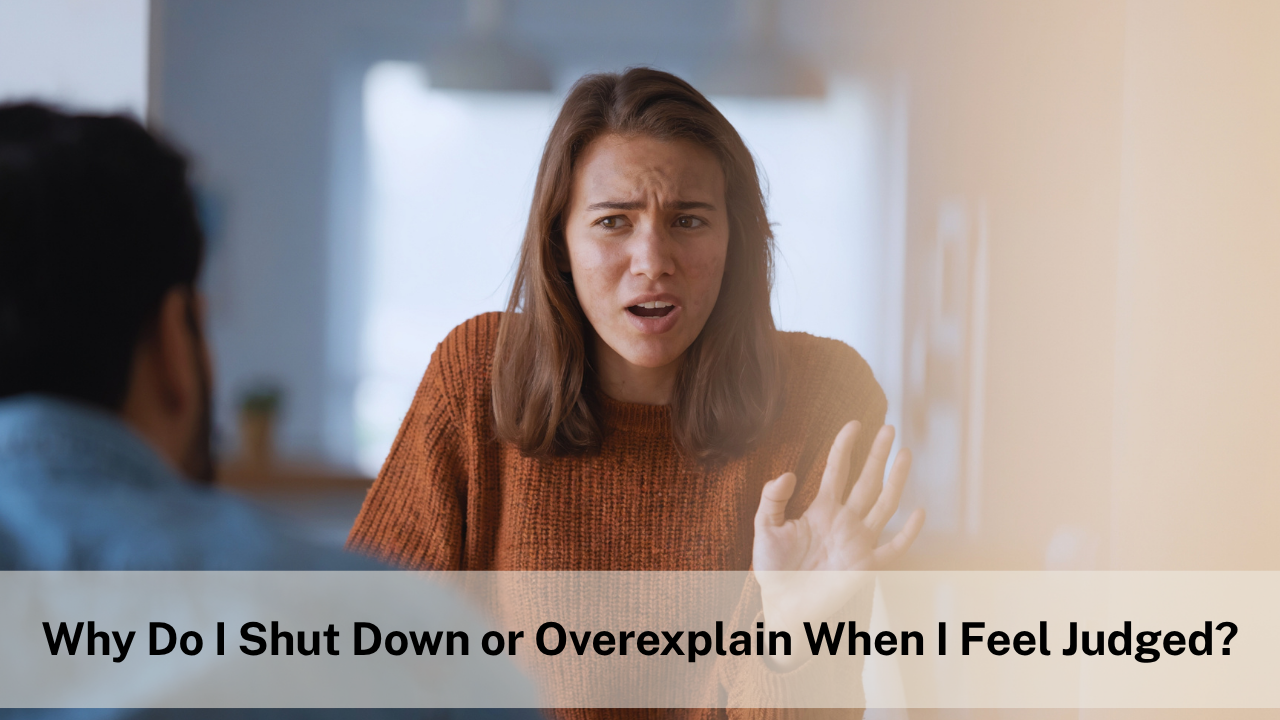
Why Do I Shut Down or Overexplain When I Feel Judged?
Have you ever walked away from a conversation thinking, Why didn’t I say what I wanted to say?
Or maybe you had the opposite experience. You said what you wanted to say and then kept going. You explained it again. You justified it. You gave another example. You tried to make sure the other person understood exactly why you were right.
Both reactions can happen when we feel judged.
One person gets quiet.
Another person talks more.
At first, those behaviors seem completely opposite. But underneath them may be the same thing:
I am trying to protect myself.
That was one of the biggest realizations in a recent Women’s Power Hour session on trusting your own voice. We explored what I call the Silent Voice, the Proving Voice, and the Empowered Voice. The Silent Voice gives away the conversational space. The Proving Voice takes over the space. The Empowered Voice learns how to share the space without needing to control what happens next.
Where Does the Silent Voice Come From?
I understand the Silent Voice because I have had one.
I am the youngest of six children. Growing up in a large household, being heard was not always easy. I wasn’t raised with the exact message that children should be seen and not heard, but there were certainly ways we knew when we had said too much or crossed a line.
My mother had a look.
We all knew the look.
And she had very strong fingernails. If we were sitting in church and misbehaving, those fingernails tapping the top of your head were enough to tell you to straighten up quickly.
You learned to behave.
You learned when to speak.
You learned when it was probably better not to.
For some people, that lesson goes much deeper. Speaking up may have actually felt dangerous. Maybe the message was, Don’t tell anyone. Maybe speaking could get you or someone else in trouble. Maybe there was anger, punishment, embarrassment, or rejection when you expressed yourself.
So the Silent Voice learns:
If I don’t speak, you can’t judge me.
That doesn’t necessarily mean you become a shy person. I certainly didn’t. I was expressive, creative, and comfortable around friends and in school. Even today, though, if I walk into a wedding or gathering where I don’t know many people, I am probably not going to be the person working the room and introducing myself to everyone.
The Silent Voice can be situational.
It can appear when authority walks into the room.
When someone becomes angry.
When there is something at stake.
When your job, relationship, belonging, or sense of safety feels threatened.
You know what you want to say. Your body simply tells you it may not be safe to say it.
Then There Is the Proving Voice
At some point, some of us swing in the other direction.
We decide we are tired of not being heard.
So now everyone is going to hear us.
I jokingly call this the diarrhea-of-the-mouth voice.
It is the person who explains everything. Then explains the explanation. She may interrupt, correct, teach, justify, or make sure everyone knows she knows what she is talking about.
She may be labeled a “know-it-all.”
I can admit that this voice has been part of my life too.
There was a time when I could figure things out and then become frustrated that other people couldn’t figure them out. I had learned it. Why hadn’t they?
That can easily turn into judgment from the other direction.
I know. You don’t.
But underneath the Proving Voice may still be insecurity.
If I keep control of the conversation, you don’t have much room to judge me.
The Silent Voice says, If I don’t speak, you can’t judge me.
The Proving Voice says, If I don’t stop speaking, you won’t have the chance.
Neither one is really free.
Sometimes Overexplaining Sounds Very Reasonable
The Proving Voice doesn’t always look dramatic.
Sometimes it sounds polite.
During Women’s Power Hour, one participant practiced how she might handle a situation where she had previously felt ignored. She started with a thoughtful explanation of why she would like to be included in a future meeting.
But underneath that explanation was something familiar:
Let me first show you that I am reasonable and helpful so you won’t think badly of me when I ask for what I want.
We removed the justification.
The empowered statement became much simpler:
“In the future, I would appreciate being invited.”
Period.
She didn’t need to establish that she was a good person first.
She didn’t need to prove why she deserved the invitation.
She could simply ask.
That little preamble is something I notice often in my Spiritual Counseling work, because it usually points to a deeper fear of being judged, misunderstood, or seen as selfish.
I don’t want you to think I’m selfish, but…
I know they have a lot going on, but…
I’m really trying to be understanding, but…
Sometimes all of that language is an attempt to protect ourselves before we ever get to the thing we actually want to say.
The Empowered Voice Doesn’t Need to Win
This is where the Empowered Voice is different.
My definition is simple:
I have no expectation that you will agree with me. All I ask is that you honor that I have an opinion.
That changes the conversation.
I am no longer trying to make you agree.
I am no longer trying to prevent you from judging me.
I am no longer trying to convince you that I am right and you are wrong.
I am simply saying what is true for me.
And then comes the hard part:
Stop talking.
Let there be silence.
Let the other person respond.
Let them think whatever they are going to think.
That is where self-trust starts to show itself.
Judgment Is Going to Exist
In Spiritual Counseling, I don’t teach people that they should somehow become immune to judgment.
Judgment is part of being human.
It is one of the ways we compare. We decide what we like and what we don’t like. We compare someone else’s choices with our own experiences, beliefs, values, insecurities, and programming.
Someone’s judgment of you is first and foremost their opinion.
What matters is what happens when that opinion reaches you.
If it doesn’t land at all, you may simply be able to say:
“Thanks for your opinion.”
And stop.
If someone makes a judgment about the person you used to be, you might recognize that too.
Yes, that used to be true. I’ve done a lot of work around that, and it isn’t who I am today.
You don’t have to fight with them about the version of you they still carry in their mind.
But sometimes judgment hits hard.
That is worth noticing.
If someone says something and you immediately feel wounded, defensive, angry, or desperate to prove them wrong, ask yourself:
What about that landed?
There may still be some part of you that believes it.
That doesn’t make their judgment correct. It makes the interaction useful information.
Sometimes the person who irritates us most becomes a very effective teacher.
You may even be able to say:
Wow. That really hit me. There must still be something in there for me to look at.
Or, if the comment itself crossed a line:
“Did you mean for that to be hurtful?”
Now you have stopped reacting and brought awareness back into the conversation.
I Had to Learn This Too
Years ago, I rented a space for my business. I had moved from about 250 square feet into a 1,500-square-foot facility and hired contractors to renovate it.
There were complications with work left behind by previous tenants, extra repairs, and eventually questions from the landlord about the bill.
I remember immediately feeling judged.
I felt as though I was being treated like someone who didn’t understand business or buildings. I became tense. At first, I froze.
Then I gathered myself and explained the facts of what had happened. We eventually came to an agreement.
Years later, that building changed ownership, and my relationship with the new landlord became much more difficult. I often felt as though I had to defend what I knew, while at other times I avoided dealing with him altogether.
That situation taught me something important.
The more I tried to manage what he thought about me, the more exhausting the interaction became.
Eventually, I changed the way I communicated.
I made one factual statement.
Then I stopped.
If he wanted to fill the silence, he could fill it.
I reminded myself:
This is about him. I do not have to accept his judgment as my truth.
That was the Empowered Voice.
Not louder.
Not meaner.
Not more convincing.
Just clearer.
Your Body Usually Knows Before Your Mouth Does
This is one of the most important parts of the work for me.
Trusting your voice isn’t only about choosing better words.
It is also somatic.
Your body knows when you feel threatened.
You may lean backward.
Lock your knees.
Tighten your jaw.
Pull your shoulders in.
Cross your arms.
Make yourself smaller.
Or you may physically prepare for battle.
That is why I come back again and again to:
Pause. Breath. Notice. Choose.
Pause before automatically doing what you have always done.
Breathe.
Notice what is happening in your body.
Then choose.
Sometimes the choice is simply to stand up.
Put both feet firmly on the ground.
Allow your spine to lengthen.
Relax your shoulders and jaw.
Let your hands remain open rather than using them as a shield.
Take up your space.
During Women’s Power Hour, one woman talked about how powerful it felt to physically stand during this practice. With her feet grounded, she experienced the conversation differently. She could listen without becoming emotionally attached to every word the other person said.
That is the work.
You are teaching your body that you don’t have to disappear.
And you don’t have to fight.
You can stand.
Sometimes the Empowered Answer Is “I Don’t Know Yet”
Using your voice doesn’t mean having an immediate answer.
If someone springs something on you and you can feel your nervous system going into high alert, an empowered response might simply be:
“I don’t know that I have an answer right now.”
Or:
“I need some time to think about that.”
Or:
“I can see that you’re upset. This probably isn’t the best time for us to have this conversation. Let’s come back to it.”
Those are not weak answers.
They are choices.
The old version of you may have frozen, agreed, defended, or started producing an entire case for why you were right.
The Empowered Voice can take time.
You Have the Right to Have a Voice
This is ultimately what I want people to remember.
You have a right to speak.
You have a right to have an opinion.
You have a right to change your opinion.
You have a right to say that you need time.
And you have a right to let someone disagree with you.
Nobody can take your voice away from you.
The work is learning how you want to use it.
Not from the frightened child who learned to stay quiet.
Not from the proving part of you that believes you must control the room.
But from the part of you that can stand upright, breathe, speak clearly, and trust:
My voice does not require your agreement to be valid.
The next time you feel yourself shutting down or beginning to overexplain, pause.
Breathe.
Notice your body.
Stand if you can.
Feel your feet underneath you.
Then ask:
What does my Empowered Voice actually need to say?
Say that.
And give yourself permission to stop there.